Where Can I Learn to Use Martial Arts Weapons

Filipino martial arts (FMA) (Filipino: Sining panlaban ng Pilipinas) refer to ancient Malay and newer modified fighting methods devised in the Philippines. It incorporates elements from both Western and Eastern Martial Arts, the near popular forms of which are known as Arnis, Eskrima, and Kali. The intrinsic need for self-preservation was the genesis of these systems. Throughout the ages, invaders and evolving local conflict imposed new dynamics for combat in the islands now making up the Philippines. The Filipino people adult boxing skills as a direct result of an appreciation of their ever-changing circumstances. They learned often out of necessity how to prioritize, allocate and use common resources in combative situations. Filipinos have been heavily influenced past a phenomenon of cultural and linguistic mixture. Some of the specific mechanisms responsible for cultural and martial change extended from phenomena such every bit war, political and social systems, technology, trade and practicality.
Filipino martial arts take seen an increase in prominence due to several Hollywood movies and the teachings of modern masters such as Venancio "Anciong" Salary, Dan Inosanto, Roland Dantes, Edgar Sulite, Cacoy Canete, Danny Guba, Mike Inay, Remy Presas, Wilson Pangan Sr. (Thousand Primary), Ernesto Presas Sr., Doug Marcaida, Ernesto Presas Jr., Carlito A. Lanada, Sr., Carlos Deleon[i]
There accept been numerous scholarly calls on the inclusion of the many martial arts of the Philippines into the UNESCO Intangible Cultural Heritage Lists. As of 2019, a total of nine elements scattered in eight countries, such equally Thailand, Georgia, and Korea, have successfully inscribed their martial arts in the UNESCO list.[2]
History [edit]
Today there are said to be almost every bit many Filipino fighting styles every bit at that place are islands in the Philippines. In 1972, the Philippine authorities included Filipino martial arts into the national sports loonshit. The Ministry building of Instruction, Civilization and Sports besides incorporated them into the concrete didactics curriculum for high school and college students. In recent history, Richardson C. Gialogo and Aniano Lota, Jr. helped the Department of Education (DepEd), former Ministry of Education, Culture and Sports, in the promotion of Arnis in the public schools. The Task Forcefulness on Schoolhouse Sports (TFSS) headed by Mr. Feliciano Toledo asked Richard Gialogo and Jon Lota to conduct national, regional and provincial seminar-workshops all over the Philippines under the auspices of the Philippine regime. This resulted to the inclusion of Arnis in the Palarong Pambansa (National Games) in 2006. The efforts of the ii and Senator Miguel Zubiri resulted in Arnis being declared equally the National Martial Art and Sport of the Philippines by virtue of Republic Act 9850 which was signed into law in 2009. Noesis of the Filipino fighting skills is mandatory in the Philippine armed services and police.
Filipino martial arts are considered the almost advanced applied modernistic blade arrangement in the world and are at present a cadre component of the U.S. Army'southward Modernistic Regular army Combatives programme[3] [iv] [5] and used by the Russian Spetsnaz (special forces).[half-dozen] [7] [8] The Authorities of Bharat used Filipino martial arts to train their Para (Indian Special Forces) of Indian Army, National Security Guard, MARCOS of Indian Navy and Commandos of Key Armed Police Forces.
Weapons [edit]

Traditional bolos from the Visayas (ginunting on the left, and iii talibongs).
Filipino martial artists are noted for their ability to fight with weapons or empty hands interchangeably and their ability to plough ordinary household items into lethal weapons. Weapons-preparation takes precedence because they give an edge in real fights, gears students to psychologically confront armed opponents, and whatever object that can be picked up tin can be used every bit a weapon using FMA techniques. Empty hand grooming techniques are translated from the use of the Daga (dagger) or Baston (stick).
Another affair to note is that the Philippines is a bract civilisation. The Southern Philippines with the Moros were never actually conquered by the Spaniards or the Americans; nor the Northern mountains of Luzon with their feared headhunter tribes so they kept their weapons and their fighting skills. For the more than "Christianized" provinces and the towns where citizens had been "disarmed", bolos (a cutting tool similar to the machete) and other knife variants are all the same unremarkably used for general work (farming in the provinces, chopping wood, coconuts, decision-making talahib (sword grass), which could grow higher than roofs if non cut, etc.) and the occasional bloody fight. Production of these weapons yet survives and there are a few who still brand some. In the province of Aklan, Talibongs are withal existence fabricated in the remote areas. Until the 80s, balisong knives were nevertheless unremarkably used in the streets of Manila as general purpose pocket knives much like Swiss ground forces knives or box cutters until new laws on commanded kinds of knives made information technology illegal to carry them in public without a permit or proof that information technology was a vital to ane's livelihood (east.g. Martial arts teacher, vendor). They're still openly sold in their birthplace of Batangas, in the streets of Quiapo, souvenir shops and martial arts stores, wielded by practitioners and street gangs. Thus, even when fighting systems were outlawed by the Spaniards, Filipinos however maintained their centuries-old relationships with blades and bract fighting techniques that survive from aboriginal times and are however much alive equally they have been adapted and evolved to stay relevant and applied in colonial and mod times.
What separates Filipino Martial Arts from other weapon-based martial arts like Japanese Kendo & Kenjutsu, European Fencing and traditional Chinese Martial arts that teach the usage of classical Chinese weapons is that FMA teaches weapon use that is practical today: how to use and deal with weapons that one tin actually encounter in the streets and how to turn ordinary items into improvised weapons. No one walks around with sabers, katanas or jians anymore, only knives, machetes, clubs and clothing, (chosen Sarongs), are still among commonly encountered weapons on the street and in the field, thus making FMA very applied and geared towards military machine and street fighting.
Traditional weaponry varies in blueprint, size, weight, materials, and the style these weapons are used. But considering of similar techniques Filipinos can use whatsoever object and turned into a weapon by a Filipino martial creative person as a strength multiplier.
Unarmed [edit]
- Mano Mano: (From Castilian mano, pregnant hand lit. paw to hand) Incorporates punches, kicks, elbows, knees, headbutts, finger-strikes, locks, blocks, grappling and disarming techniques.
- Suntukan (also known equally Pangamot in the Visayas and "Panantukan" in the The states): General term for hand-based & punching techniques.
- Sikaran: Kicking techniques, also a kicking-based divide art practiced in Rizal province.
- Dumog: Filipino style of grappling. Practiced in Antique in Panay.
- Buno: Filipino way of wrestling.
- Bultong/Boltong: Native fighting arts with wrestling and slapping from the Igorot people of Northern Luzon.
- Yaw-Yan or Sayaw ng Kamatayan: (Dance of Death) Yaw-Yan closely resembles Muay Thai, but differs in the hip-torquing motion as well equally the downwards-cut nature of its kicks, and the emphasis on delivering attacks from long range (while Muay Thai focuses more than on clinching). The forearm strikes, elbows, punches, dominating palms, and hand movements are empty-manus translations of the bladed weapons. There are 12 "bolo punches" which were patterned from Arnis.
Touch [edit]
- Baston / Olisi: Short sticks, traditionally crafted from rattan or kamagong
- Bangkaw / Tongat: Staff, rod or pole
- Dulo-Dulo: Palmstick
- Tameng: Shield
- Improvised weapons: pens, keychains, keys (push knife grip), umbrellas, rolled-up newspapers/magazines, walking sticks, etc.
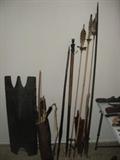
The walking stick in the middle of photo but left of the 3 arrows and right of the Luzon shield, doubles as an improvised weapon coming autonomously into two pieces, both with fixed blades on a long and brusk stick.

Pictured to a higher place is a closer look at the carving of a Negrito homo on top of the stick.

A braid/weave encompasses the top portion of the walking stick to ensure a expert grip. While partially unsheathed, the ii blades tin can be seen hidden inside. Very rare from late 19th to early 20th century, beautiful weapon and smashing case of ingenuity and master craftsmanship of the people.
Edged [edit]
- Daga/Cuchillo: Spanish for dagger and pocketknife respectively. Traditional varieties include the gunong, punyal (from Spanish puñal) and barung or barong
- Balisong: Butterfly knife
- Karambit: Small blade shaped like a tiger claw
- Espada: Spanish for "sword". Includes kampilan, ginunting, pinuti and talibong
- Itak: Bolo used by Tagalog people
- Kalis: Larger, thicker Filipino kris
- Golok: Machete or broadsword used by tribes people
- Sibat: Spear
- Sundang: Single-edged thick short sword
- Lagaraw: Single-edged flexible long sword with a bent tip
- Ginunting: Unmarried-edged flat basis short sword with a double edged sheep's hoof tip. Typically used in matched pairs with Pinunting
- Pinunting: Single edged v-ground short sword with backswept tip. Typically used in matched pairs with Ginunting
Flexible [edit]
- Latigo: Spanish (sp. látigo) for whip
- Buntot Pagi: Stingray tail
- Lubid: Rope
- Sarong
- Cadena / Tanikala: Spanish and Tagalog (Tanikalâ) respectively for chain
- Tabak-Toyok: Two sticks attached together past rope or chain, similar to nunchaku, but with shorter sticks and a longer chain
- Improvised: Belt, bandana, handkerchief, shirt, towel
Projectile [edit]
- Pana at Palaso: Bow and arrow
- Sibat: Spear
- Sumpit: Blowpipe
- Bagakay: Darts
- Tirador/Pintik/Saltik: Spanish, Cebuano and Tagalog for slingshot respectively.
- Kana (as in Indian Pana Kakana-kana/kakanain kita): Darts propelled by slingshots used past street gangsters
- Lantaka: kerosene-propelled bamboo cannon
- Luthang: gas-powered mini bamboo cannon
Training [edit]
Signs and symbols [edit]

Many Filipino martial art grooming halls incorporate the triangle into their logo.
The triangle is one of the strongest geometrical structures and stands for force. Many preparation halls contain the triangle into their logo. It represents numerous underlying philosophical, theoretical and metaphysical principles in the Filipino martial arts. Applications of the triangle are found in defensive and offensive tactical strategies, including footwork, stances, blocking and disarms.
The triangle also represents a trinity of deities. Majority of ethno-linguistic groups in the country are known to accept a trinity of ancient gods and goddesses, embodying the number three as sacred.
During training, not-exact gesture advice and recognition is used in teaching and identification. This sign linguistic communication, utilizing hand, torso and weapons signals; is used to convey ideas, desires, data, or commands.
Basic tactical ranges [edit]
The iii combat ranges in the Filipino martial arts are corto (Spanish for shut-range), medio (Castilian for medium-range) and largo (Spanish for long-range).
- Hakbang: general term for footwork
- Corto Mano: close range, short movements, minimal extension of arms, legs and weapons, cutting distance
- Serrada: "separate pace", short range footwork, quick, divide action, front end and back, low stance. Serrada footwork is the base of a triangular framework methodology
- Largo Mano: long range, extended movements, full extension of arms, legs and weapons, creating distance
- Fraile: brusque range footwork, hopping action, counterbalanced position, short hop, pushing off from the lead pes
- Retirada: short range footwork, shuffling activeness, pushing astern by pushing off the lead foot, giving vi to eight inches of range per activeness.
- Banda y banda: side to side activeness
Basic tactical methods [edit]
Filipino martial arts contain a broad range of tactical concepts, both armed and unarmed. Each art includes several of the methods listed below. Some of these concepts take been taken in isolation to serve equally the foundation for entire fighting systems in themselves.
Unarmed tactical methods [edit]
Striking [edit]
- Mano Mano, Suntukan, Pangamot, de Cadena, Cadena de Mano, panantukan - empty hands
-
- Suntukan , Panantukan, Dirty Boxing - empty-manus striking (usually with closed fist) with elbows, headbutts and low kicks
- Paa Paahan, Paa- foot; feet; hoof; foot to; feet to; limb; footstool; toes; legs; base; lesser; corners; Paahan-with big feet;
-
- Sikaran, kick backward; to kick backward
- Pananjakman, Sipa, patid or sikad - low kicks (heel impact point)
Grappling [edit]
- Dumog - wrestling or grappling methods with an accent on disabling or decision-making the opponent by manipulation of the caput and neck. This also refers straight to a wrestling competition on dingy ground.
- Buno
Dirty [edit]
- Kinamutay - a sub-section of pangamot that specializes in bitter and centre-gouging
-
- Pa-ak - bitter
- Pakug - headbutting
- Sablig - throwing natural heart irritants such as sand to the unwary opponent
- Kawras or kamras - scratching assail to sensitive parts such as the eyes
Armed tactical methods [edit]
-
- Solo baston - single stick
- Doble Baston - double stick
- Bati-Bati - butt of stick methods
- Dulo-Dulo/Dulo y Dulo - palm stick methods
- Bantay-Kamay, Tapi-Tapi- "guardian hand" or "alive hand", auxiliary weapon used in conjunction with the chief weapon for checking, blocking, monitoring, trapping, locking, disarming, striking, cut, etc. Examples include the empty hand when using a unmarried stick or the dagger when fighting with sword and dagger
- Baraw - pocketknife and dagger
- Mano y Daga - paw and dagger
- Baston y Daga - stick and dagger
- Daga y Daga - pair of daggers
- Espada y Daga - sword and dagger
- Latigo y Daga - whip and dagger
- Tapon-Tapon - mitt thrown knives and weapons tactics
Drilling tactical methods [edit]
-
- Numerado - hit and blocking by the numbers, refers to the almost basic strikes and angles
- Cinco Teros - five strikes, refers to the v well-nigh basic strikes and counters
- Doblete - two-weapon blocking and countering method of doubles
- Sinawali - "weaving"; rhythmic, flowing, striking patterns and tactics, utilizing ii bear upon or edged weapons.
- Redonda - circular double-stick vertical downward pattern of six strikes
- Ocho ocho - repeating pattern, strikes and tactics, such as the figure-eight. This besides refers to a dance move.
- Palis Palis - meeting forcefulness with force
- Free flow - live interaction and play, flowing do, rapid, rhythmic, weapons tactics
Technical tactical methods [edit]
-
- Abaniko - fanning techniques
- Witik - whipping, snapping dorsum or picking movements
- Lobtik - follow-through strikes; horizontal, vertical, diagonal methods
- Crossada - cantankerous blocking methods, hands and weapons
- Gunting - "scissors"; armed and unarmed scissoring techniques aimed at disabling an opponent'due south arm or hand
- Lock and block - dynamic countering, attacks based on the striking and blocking methods of the organisation
- Kadena De Mano - concatenation of easily, close quarters, continuous, empty-handed gainsay
- Hubud Lubud - to necktie and untie, continuous trapping methods
- Trankada - joint locking and breaking techniques
- Panganaw - disarming techniques
Other traditional techniques [edit]
-
- Balitok - acrobatic flip or back-flip to evade attacks. This can likewise be used in combination of kicking to striking opponents.
- Bikil, sapiti or sapid - hitting an opponent's center of gravity to cause imbalance
- Bunal, bangag or puspos - down striking with a edgeless weapon
- Bungot sa kanding - a goatee sported by men to supposedly intimidate or distract an opponent.
- Busdak - throwing an opponent downwardly to the footing
- Dunggab, duslak or luba - stealthy stabbing stroke
- Dusmo - to push an opponent'south face to the ground
- Hapak or sumbag - packed punch aimed to take downwards an opponent
- Hata - fake motility intended to open up up opponent's defensive opinion
- Ku-ot or kumot - stealthy grabbing and grappling of torso parts such as hair
- Kulata - combo punches to disable or overwhelm an opponent
- Laparo or tamparos - slapping using the lower part of the palm
- Lihay - evading attacks
- Lubag - twisting of joints to unnatural position to disable a physically stronger opponent. This includes a lethal twisting and snapping of the neck.
- Luglog - In the Waray linguistic communication this is to slit the throat
- Sagang - blocking of hitting attacks
- Tigbas - slashing and cutting stroke
- Tu-ok - strangling or locking the cervix
Other traditional techniques, kinamutay-based [edit]
-
- Pa-ak - biting
- Pakug - headbutting
- Sablig - throwing natural centre irritants such as sand to the unwary opponent
- Kawras or kamras - scratching assail to sensitive parts such every bit the optics
- Siko - to hitting with the elbow
Esoteric practices [edit]
- Agimat: A talisman worn to protect against misfortune and increase the take a chance of victory. Also known every bit habak or anting-anting.
- Albularyo: A shaman who carries out the initiation ceremony and treats injuries
- Hilot: A traditional arrangement of herbalism, massage and start-aid that was traditionally taught alongside martial arts
- Kulam or Barang : Witchcraft or spell-rituals carried out by witch-doctors. Also known as barang in Visayas.
- Oracion: Special prayers, incantations or mantra that may be recited earlier battle every bit a protective armor. This is too used for driving out or summoning spiritual entities. This is commonly written in Latin language.
Come across too [edit]
- Arnis/Eskrima/Kali
- Eskrima weapons
- Suntukan
- Kinamutay
- Sikaran
- Eskrima in popular culture
- Kuntao
- Yaw-Yan
- Pekiti-Tirsia Kali
- Alamid Martial Philippines
References [edit]
- ^ https://www.kumulua.com/abode-5/
- ^ https://ich.unesco.org/en/lists?term[]=vocabulary_ich-125
- ^ "Mod Ground forces Combatives - History". Archived from the original on June 28, 2010.
- ^ Filpino Kali is Alive and Well in Today's Police and Military Training Jim Wagner, April x, 2014, Us Dojo.com, Archived from the original on March 4, 2022 on the Wayback Motorcar.
- ^ 'Crafty Dog' teaches knife, stick fighting Michael Heckman, Fort Hood Sentry, August 6, 2009. Marc "Crafty Dog" Denny from the Canis familiaris Brothers helped Matt Larsen develop fighting methods taught in the Modern Ground forces Combatives Program
- ^ Jessica Zafra. "The Greatest Filipino Export is Kicking Ass". Philippine Star. Archived from the original on August six, 2016.
- ^ Ross Harper Alonso (June 12, 2010). "In the Stick of Things". Philippine Daily Inquirer. Archived from the original on 2010-06-15.
- ^ Ignacio, Jay (April fifteen, 2010). "The Bladed Hand: The Global Impact of Filipino Martial Arts trailer". YouTube. Archived from the original on 2021-12-11.
External links [edit]
- FMA Informative- Propagating the Filipino Martial Arts and the Culture of the Philippines
- Filipino martial arts at Curlie
- The FMA-Eskrima-Kali FAQ
- FMATalk Live! - Podcast Dedicated to the Promotion of Filipino Martial Arts
Source: https://en.wikipedia.org/wiki/Filipino_martial_arts
0 Response to "Where Can I Learn to Use Martial Arts Weapons"
Post a Comment